




Electrostatic enameling in the range and oven industry
How dry electrostatic enameling works, process steps, applications in ranges, key advantages and savings in water, chemicals and process time.
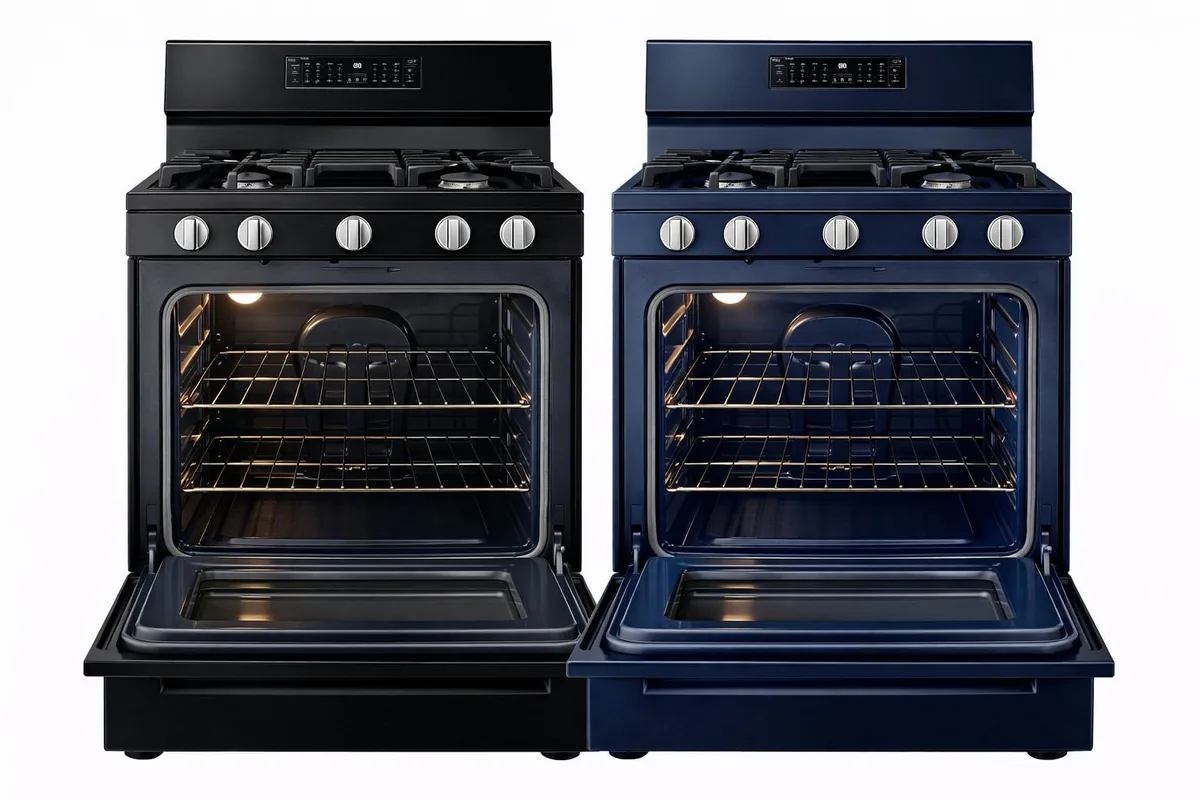
Technology, efficiency and sustainability in the range industry. Electrostatic enameling is a major technological step forward for range and oven manufacturers. The process combines the strength and durability of porcelain enamel with the efficiency of electrostatic application, delivering high-quality coatings, an excellent surface finish and better use of raw materials.
In this technical article, we explain how electrostatic enameling works, the steps of the process, where it is used on a range and the gains it brings in cost, productivity and environmental impact.
How electrostatic enameling works
Electrostatic enameling uses powdered porcelain enamel particles specially formulated for dry application.
The particles receive an electrical charge from electrostatic spraying equipment and are attracted to the metal surface of the part, which must be properly grounded. This electrostatic attraction is what makes the powder deposit evenly on the steel.
After application, the parts go to a firing furnace, where the enamel melts and forms a glassy layer bonded to the metal substrate. The result is a coating that is:
- resistant to heat, corrosion and chemical agents;
- smooth and easy to clean;
- highly color-stable.
Steps of the electrostatic enameling process
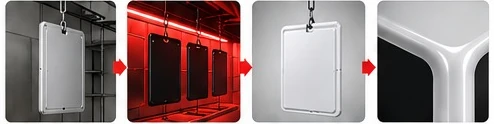
- Electrostatic application of powder enamel (dry): the hanging, grounded part receives the electrically charged powder layer.
- Firing furnace and enamel fusion: heat melts the particles, which bond to the steel.
- Enameled part with a glassy finish: leaving the furnace, the part shows a continuous, uniform layer.
- Close-up of the final finish: a smooth surface with even coverage, including edges and corners.
Applications in the range industry
Electrostatic enameling is used on many range components, with specific formulations for each application:

| Component | Main coating requirement |
|---|---|
| Side panels | Appearance, color stability and scratch resistance |
| Cooktop | Resistance to heat, spills and frequent cleaning |
| Oven cavity | Resistance to high temperatures, grease and cleaning agents |
| Grate | Resistance to direct flame and thermal shock |
| Flame spreader | Resistance to flame, heat and corrosion |
Each component needs an enamel suited to its use. Grates and flame spreaders, for example, use dedicated enamel families with high resistance to flame and thermal shock — see the options on the Market page.
Key advantages of electrostatic enameling
No degreasing, washing or pickling
Steel sheets do not need to be degreased, which eliminates washing and pickling the parts before application.
Lower costs
Fewer operations, lower consumption of water, chemicals and energy, and less effluent treatment.
Higher productivity
A simpler, faster process that can be automated.
Better material yield
Powder enamel that does not deposit on the parts is recovered and reused.
High durability
A coating resistant to heat, corrosion and wear.
Excellent finish
A smooth, easy-to-clean surface in a wide range of colors.
Impact comparison: wet process vs. electrostatic
Eliminating surface preparation steps and applying enamel dry bring significant gains in cost, process time and environmental impact. The comparison below uses the conventional wet process as the reference:
| Indicator | Conventional process (wet) | Electrostatic process (dry) |
|---|---|---|
| Water consumption (liters per 100 parts) | 100 | 0 |
| Chemical consumption (relative index) | 100 | 10 |
| Process time (relative index) | 100 | 40 |
In practice, this means no water consumption in the process, a 90% reduction in chemicals and a 60% reduction in process time compared with the wet process. Actual results vary with each line, part and set of parameters.
Conclusion
Electrostatic enameling is a relevant technological solution for range manufacturers seeking to combine quality, productivity and efficient use of industrial resources.
The ability to eliminate degreasing, washing and pickling, together with dry application and powder recovery, is a significant opportunity to simplify processes and reduce operating costs.
When combined with the right raw materials, well-tuned equipment and strict process control, this technology produces porcelain enamel coatings that are durable, attractive and aligned with the demands of modern industry.
Electrostatic enameling is therefore established as a way to add value to products, increase competitiveness and drive more efficient and sustainable industrial processes.
Technology that turns steel into durability: durability, beauty and performance for everyday life.
Frequently asked questions
What is electrostatic enameling?
It is a process in which powdered porcelain enamel particles, electrically charged by an electrostatic gun, are attracted to a grounded metal part. The part then goes to the furnace, where the enamel melts and forms a glassy layer bonded to the steel.
Does electrostatic enameling require degreasing?
No. With electrostatic enameling, steel sheets do not need to be degreased, which eliminates washing and pickling before application.
Which range parts can be enameled electrostatically?
Side panels, cooktops, oven cavities, grates and flame spreaders, each with a specific enamel formulation.
Is powder that does not stick to the part wasted?
No. Powder that does not deposit on the parts is recovered and reused, improving material yield.
What are the gains compared with the wet process?
In the reference comparison, dry application eliminates water consumption, reduces chemical use to an index of 10 (versus 100) and process time to an index of 40 (versus 100).
Vasisque Novus supplies powder enamels for electrostatic application and supports range manufacturers in choosing formulations and tuning their process. Explore the electrostatic powder line or talk to a specialist.